Good Mathematician vs. Great Mathematician
Thirteen split panels contrasting a good mathematician with a great one: how vs. why, questioning answers, rigor and intuition, abstraction, and more. Panels 9–13 come from the book Math with Bad Drawings (2018).
Transcript
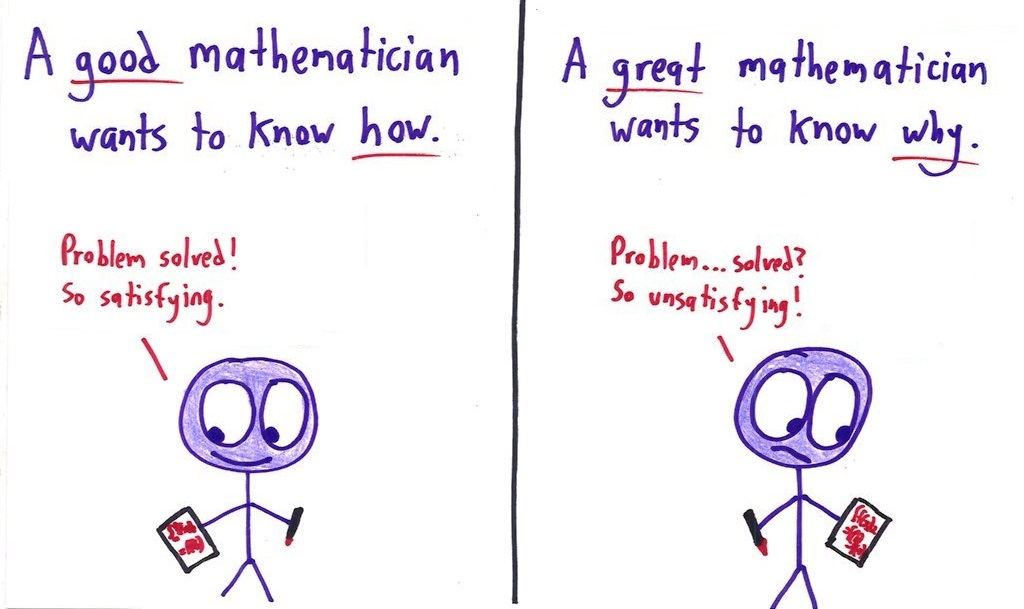
[1] A good mathematician wants to know how. ("Problem solved! So satisfying.") A great mathematician wants to know why. ("Problem… solved? So unsatisfying!")
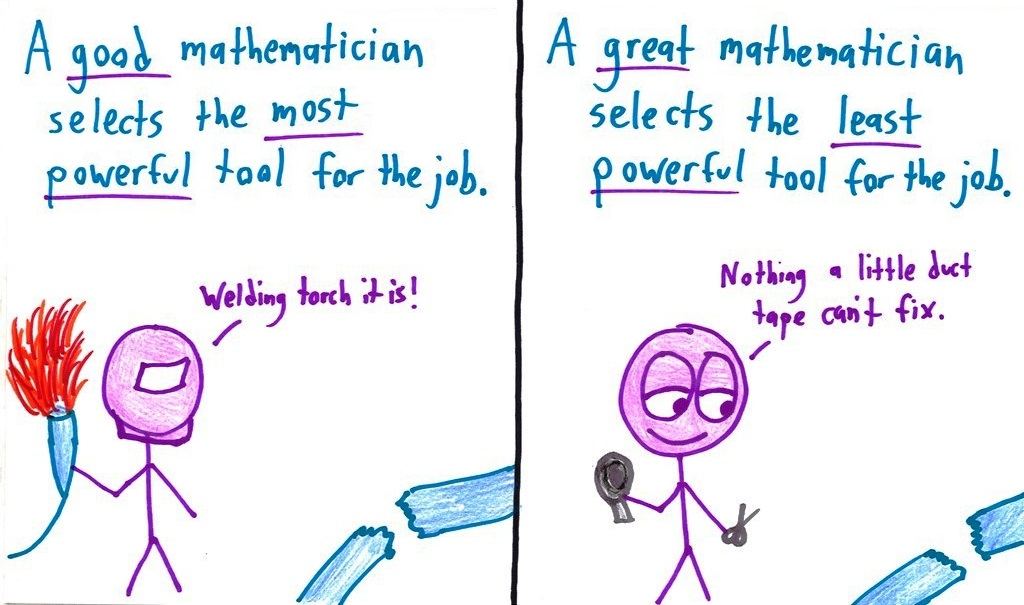
[2] A good mathematician selects the most powerful tool for the job. ("Welding torch it is!") A great mathematician selects the least powerful tool for the job. ("Nothing a little duct tape can't fix.")
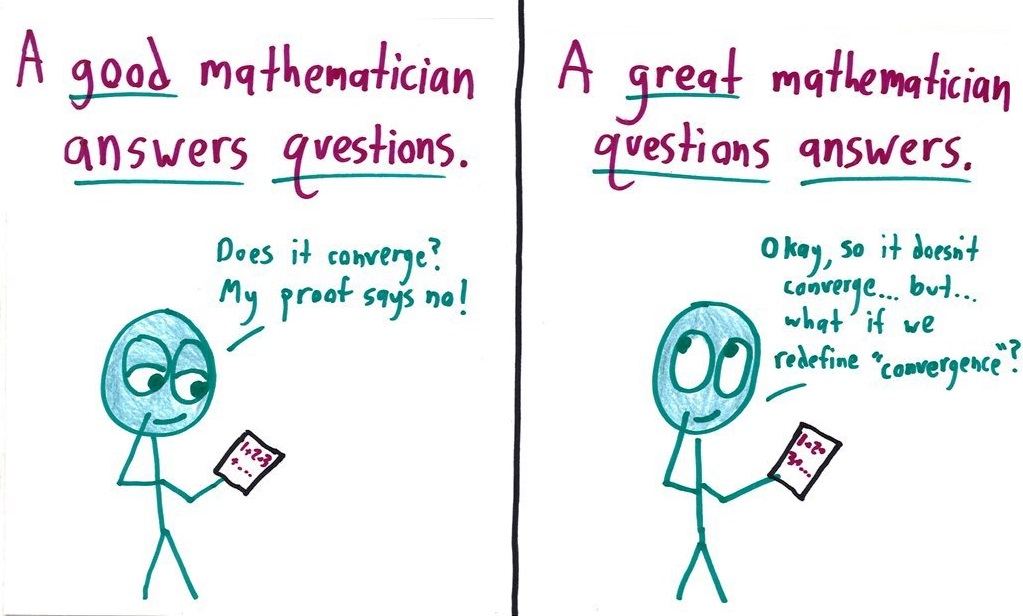
[3] A good mathematician answers questions. ("Does it converge? My proof says no!") A great mathematician questions answers. ("Okay, so it doesn't converge… but… what if we redefine 'convergence'?")
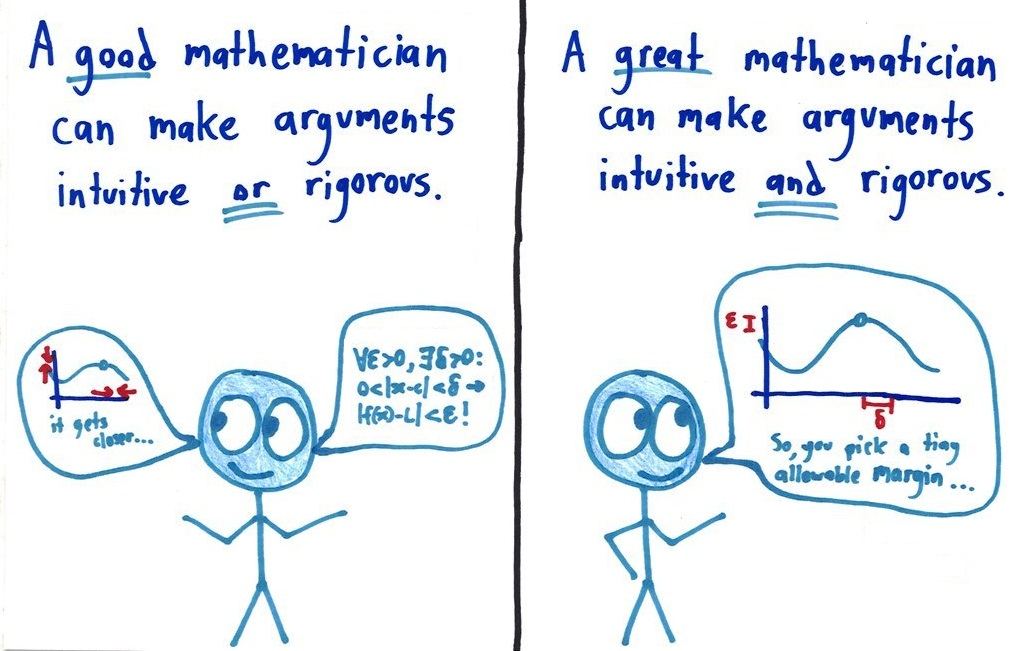
[4] A good mathematician can make arguments intuitive or rigorous. (A graph: "it gets closer…"; or "∀ε>0, ∃δ>0: 0<|x−c|<δ ⇒ |f(x)−L|<ε!") A great mathematician can make arguments intuitive and rigorous. (A graph with ε and δ: "So, you pick a tiny allowable margin…")
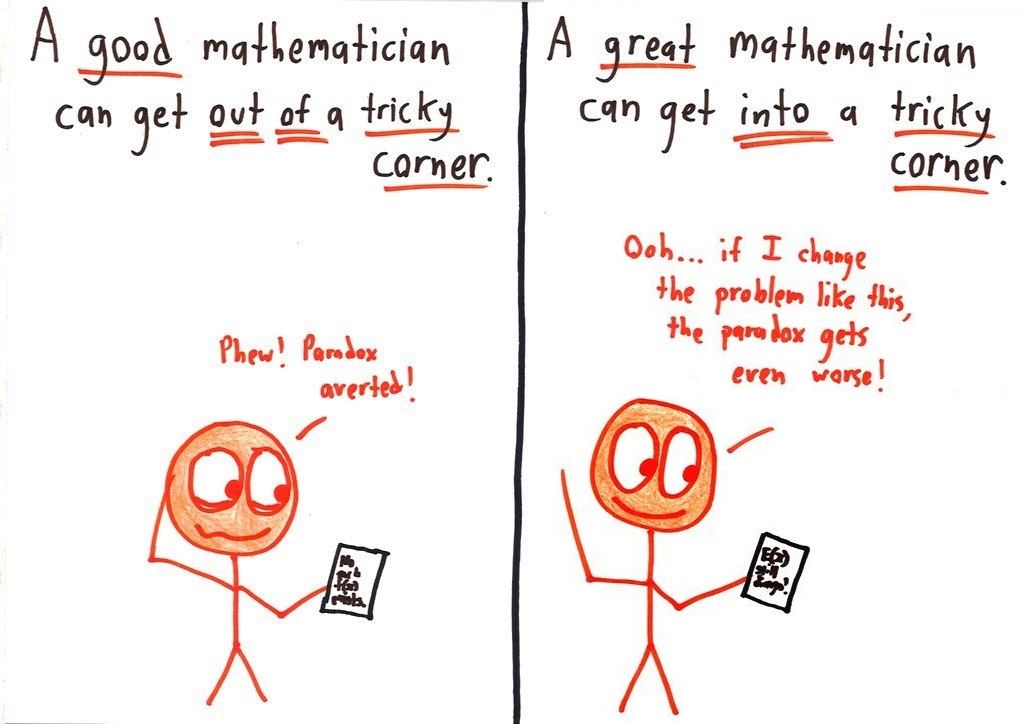
[5] A good mathematician can get out of a tricky corner. ("Phew! Paradox averted!") A great mathematician can get into a tricky corner. ("Ooh… if I change the problem like this, the paradox gets even worse!")
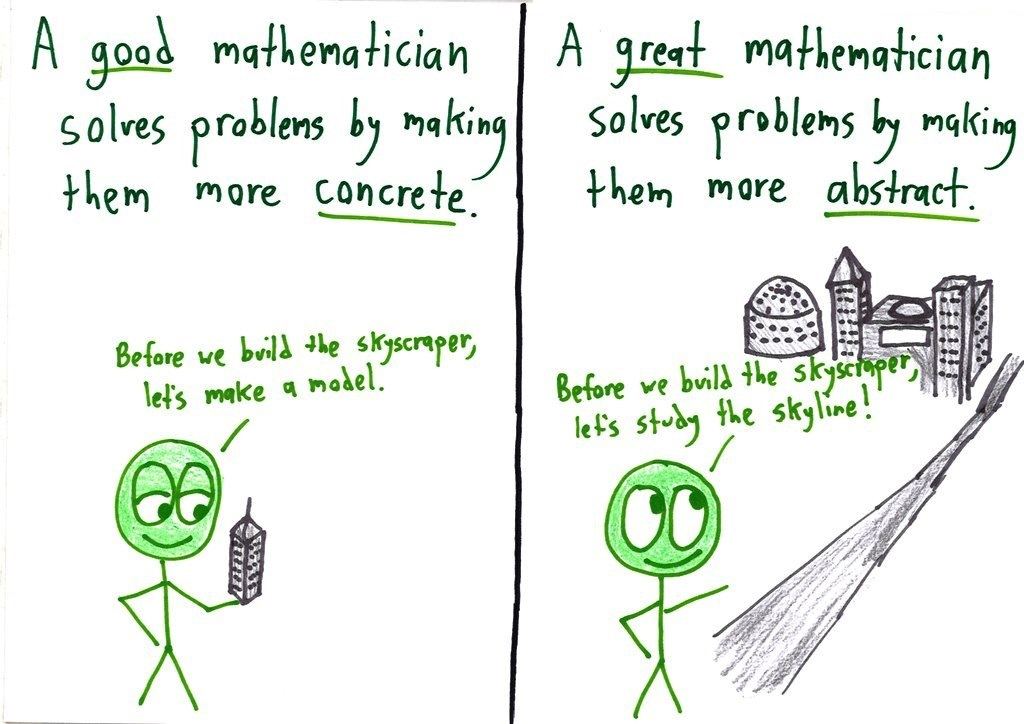
[6] A good mathematician solves problems by making them more concrete. ("Before we build the skyscraper, let's make a model.") A great mathematician solves problems by making them more abstract. ("Before we build the skyscraper, let's study the skyline!")
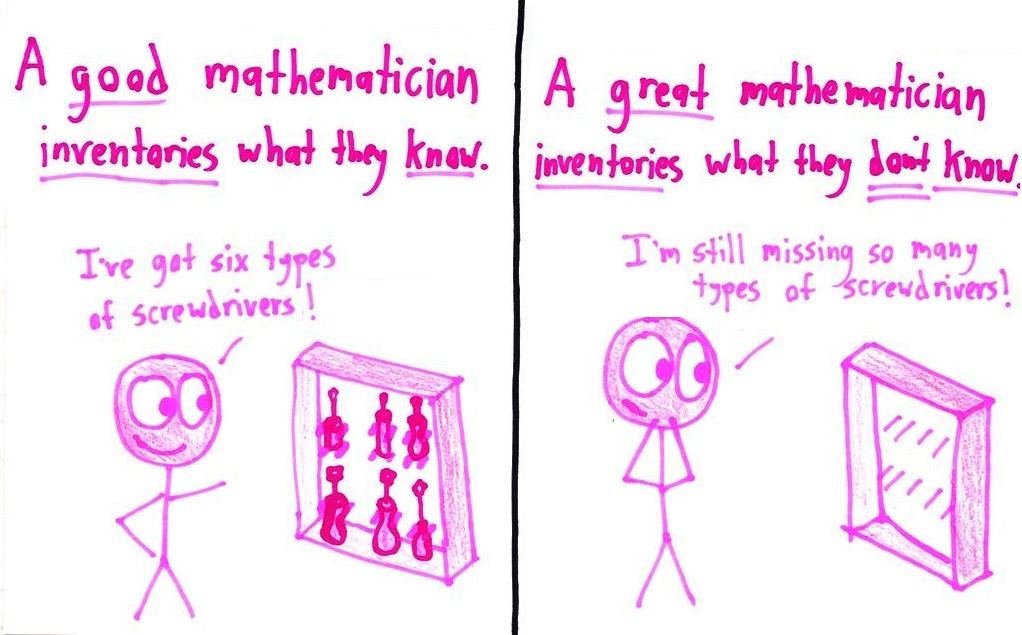
[7] A good mathematician inventories what they know. ("I've got six types of screwdrivers!") A great mathematician inventories what they don't know. ("I'm still missing so many types of screwdrivers!") [an empty toolbox]
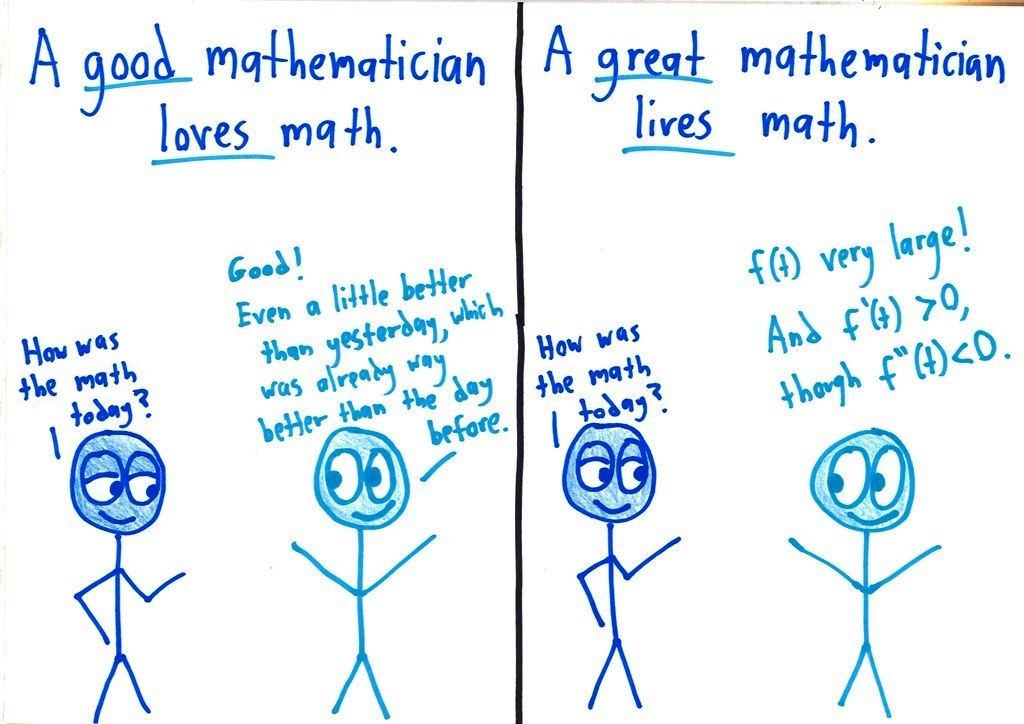
[8] A good mathematician loves math. ("How was the math today?" "Good! Even a little better than yesterday, which was already way better than the day before.") A great mathematician lives math. ("How was the math today?" "f(t) very large! And f'(t) > 0, though f''(t) < 0.")
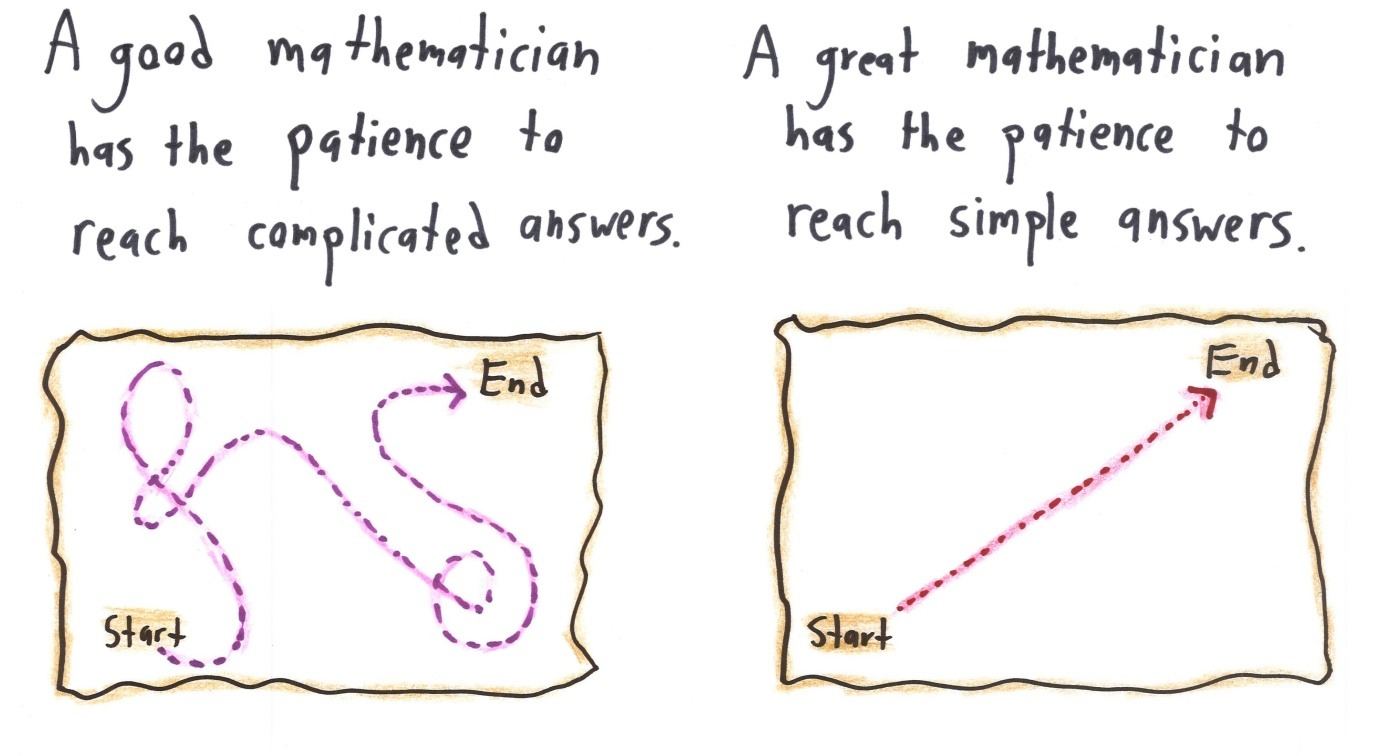
[9] "A good mathematician has the patience to reach complicated answers." [A treasure map with a long, looping path from Start to End] "A great mathematician has the patience to reach simple answers." [The same map with a straight path from Start to End]
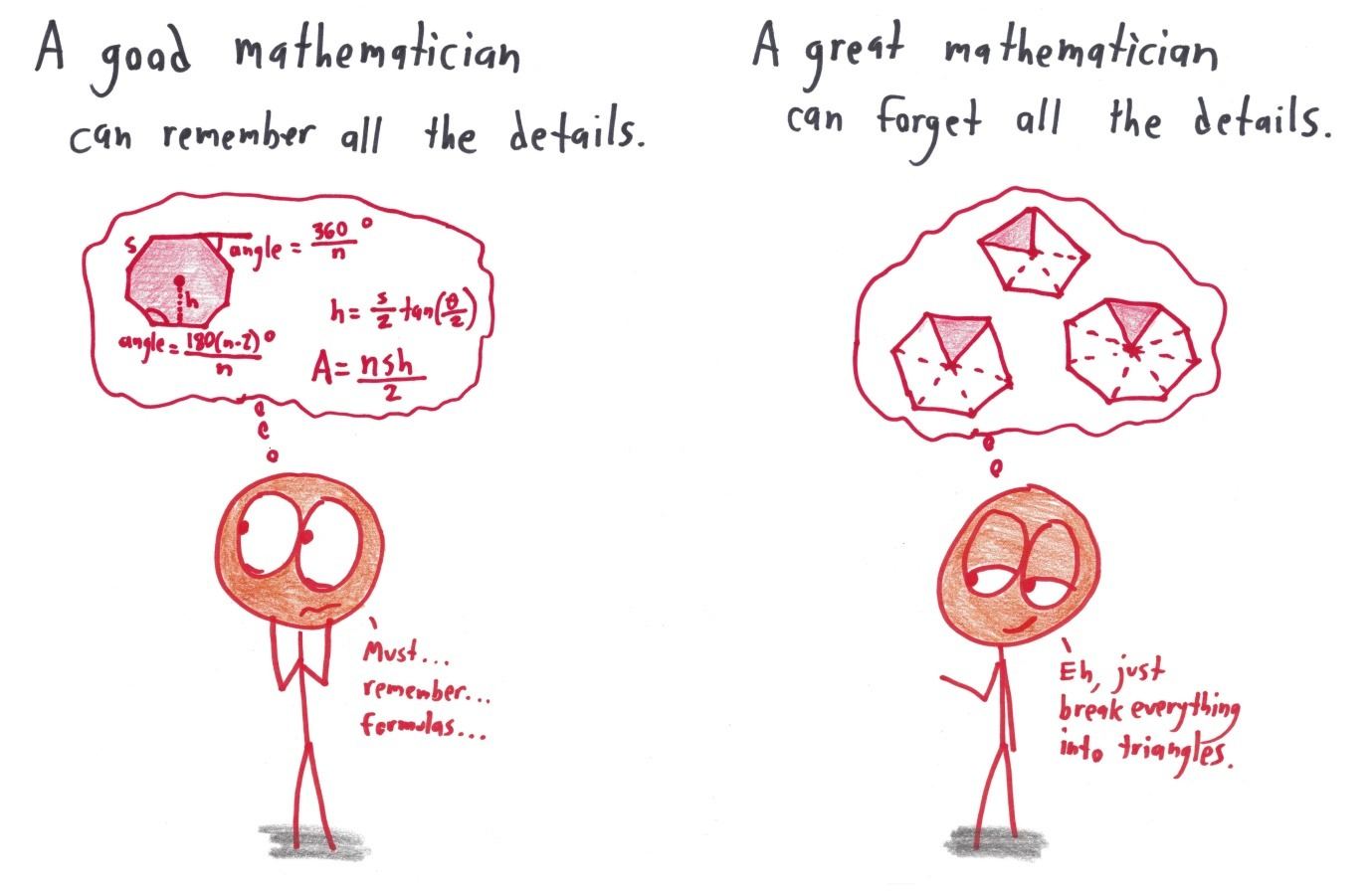
[10] "A good mathematician can remember all the details." [Thinking of a regular polygon with formulas: angle = 360°/n, angle = 180(n−2)°/n, h = (s/2)tan(θ/2), A = nsh/2] "Must… remember… formulas…" "A great mathematician can forget all the details." [Thinking of polygons cut into triangles] "Eh, just break everything into triangles."
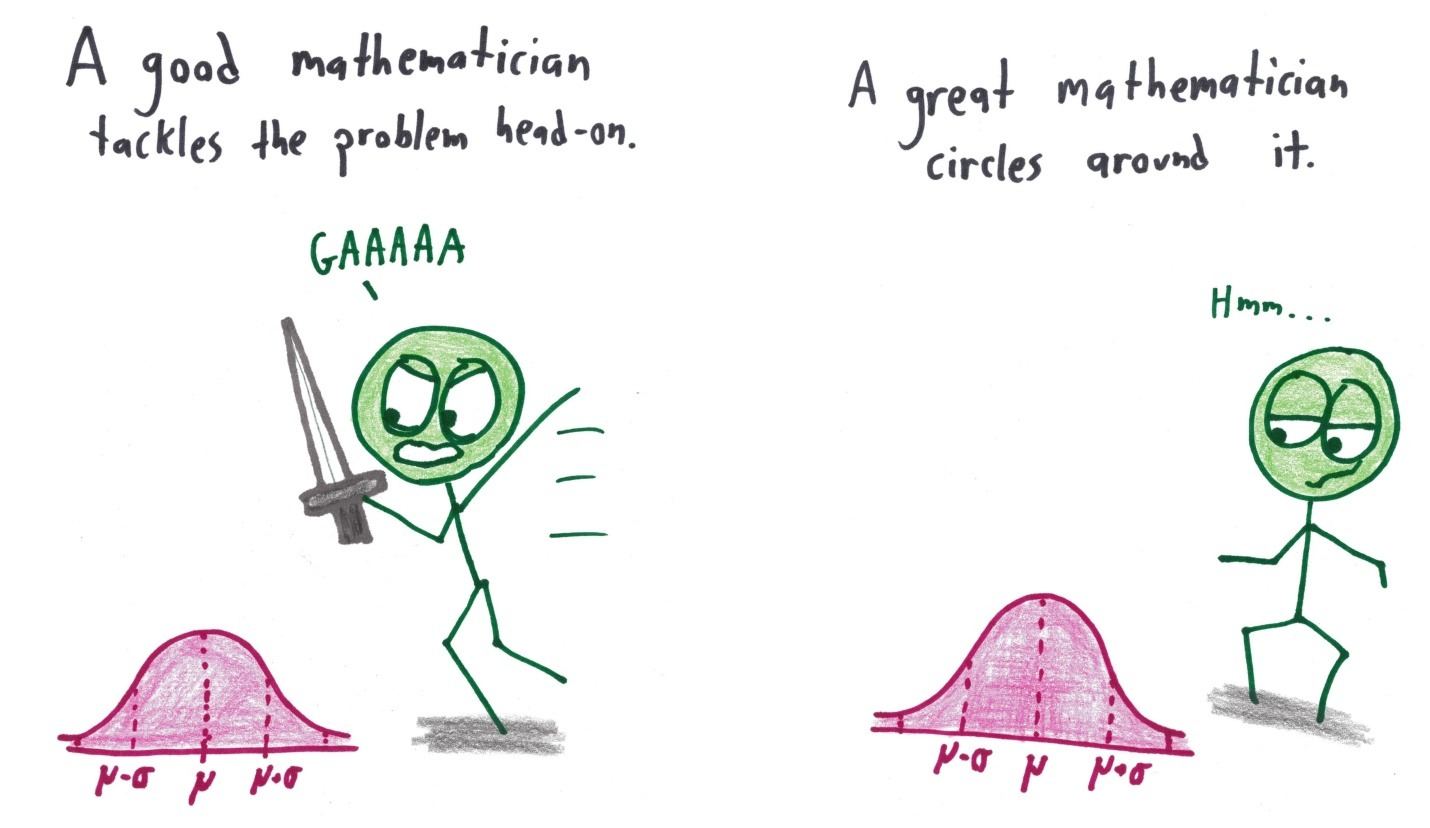
[11] "A good mathematician tackles the problem head-on." [Charging a normal curve with a sword] "GAAAAA" "A great mathematician circles around it." [Walking around the normal curve] "Hmm…"
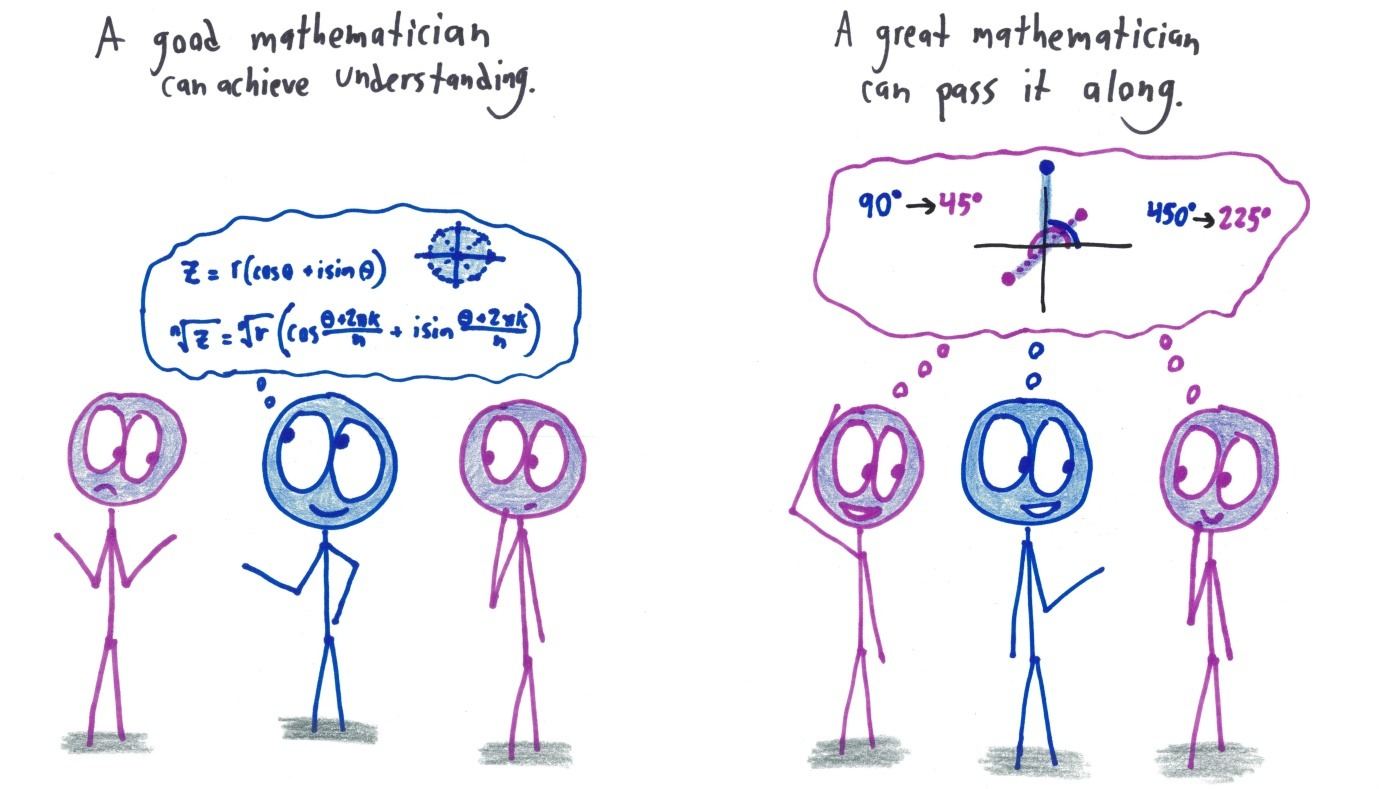
[12] "A good mathematician can achieve understanding." [One person thinks about De Moivre's formula for roots of complex numbers; two others look confused] "A great mathematician can pass it along." [All three share a picture: 90°→45°, 450°→225°]
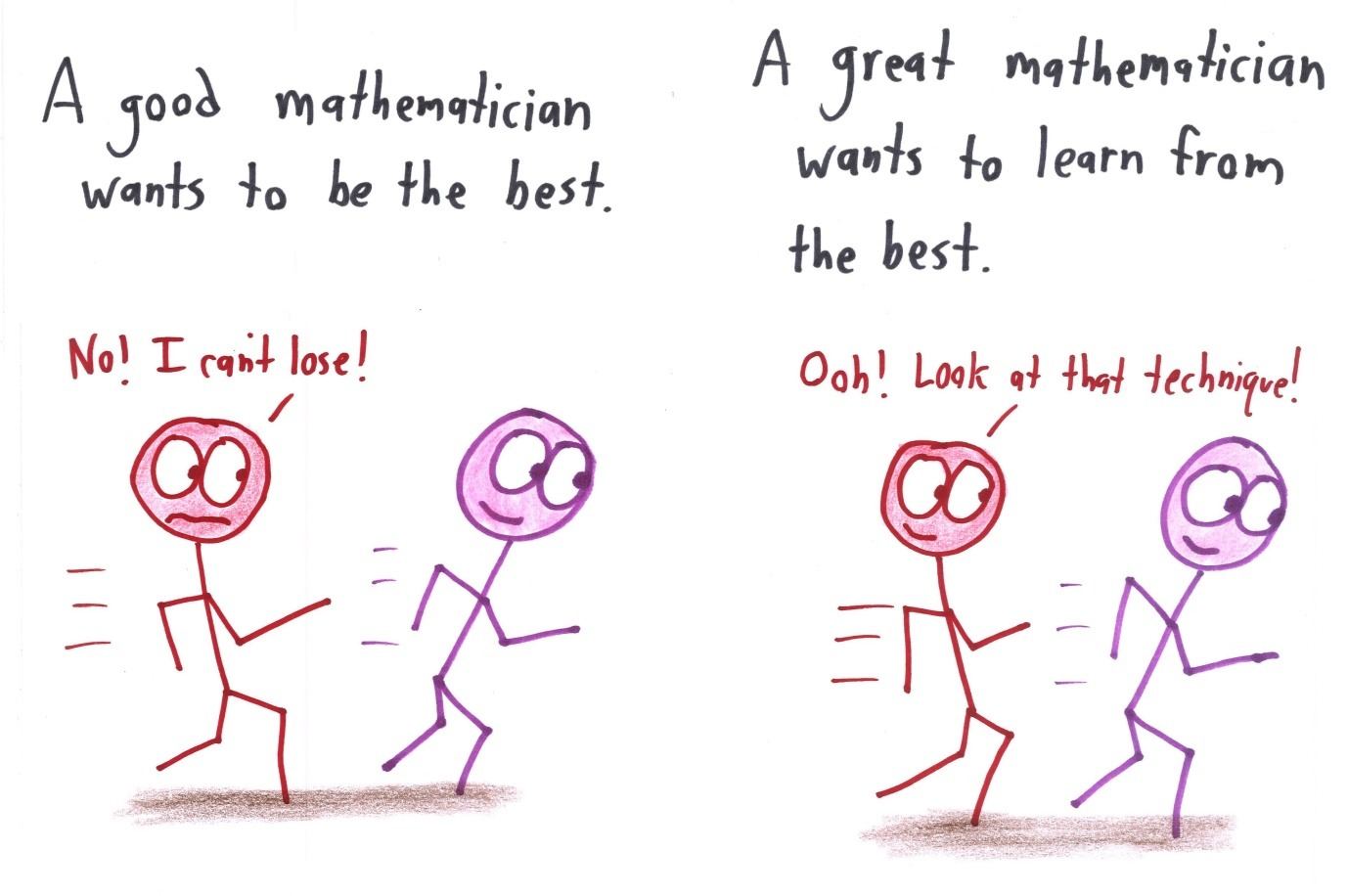
[13] "A good mathematician wants to be the best." [Two runners racing] "No! I can't lose!" "A great mathematician wants to learn from the best." [Same race] "Ooh! Look at that technique!"
Use this cartoon
Free for classrooms, worksheets, slides and other non-commercial use under CC BY-NC 4.0, with credit to Ben Orlin.
Cartoon by Ben Orlin, Math with Bad Drawings. https://cartoons.mathwithbaddrawings.com/2015-12-16-good-mathematician-vs-great-mathematician/ (CC BY-NC 4.0)